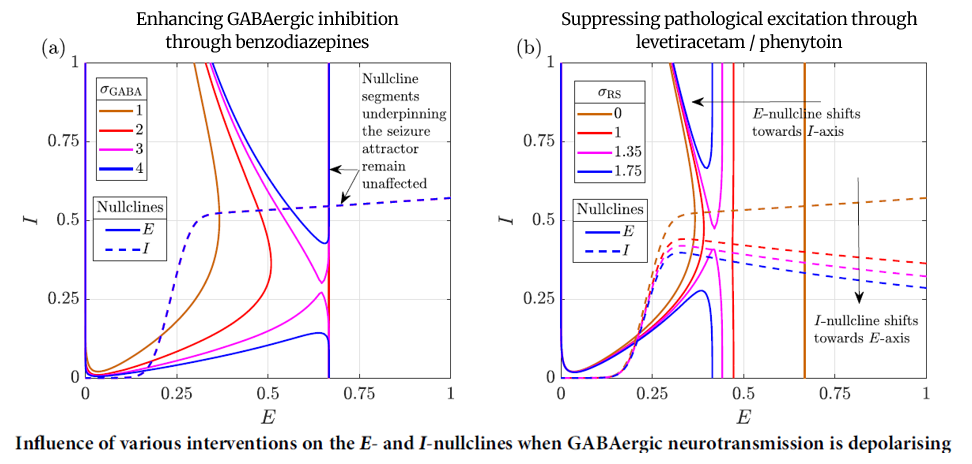
The paper “Modelling dysfunction-specific interventions for seizure termination in epilepsy”, co-authored by Aravind Kumar Kamaraj and Matthew Szuromi (Boston University, USA), has been published in the npj Systems Biology and Applications (link to published paper here). The authors use a parsimonious two-dimensional neural mass model to study why first-line treatments fail to terminate seizures in a subset of cases of status epilepticus, and why second-line interventions can succeed. Status epilepticus refers to seizures lasting longer than five minutes, or recurrent seizures without recovery in between, and constitutes a medical emergency. The analysis in the paper is anchored in NICE clinical guidelines for seizure management. Benzodiazepines are recommended as first-line treatment due to their rapid onset and potent anticonvulsant effects, yet they fail to terminate seizures in approximately 36% of cases. The model of Kamaraj & Szuromi shows that while enhancing inhibition through benzodiazepines is generally effective, this strategy can fail when the inhibitory neurotransmitter GABA becomes depolarizing. In such regimes, interventions that suppress sustained excitatory activity, such as levetiracetam and phenytoin, remain effective. From a modelling perspective, restricting the system to two dimensions allowed the authors to interpret both dysfunctions and interventions as geometric perturbations of the nullclines. Treatment can then be framed as identifying which perturbations eliminate the seizure attractor for a given dysfunction. In this way, the framework illustrates how phenomenological models can provide an intuitive map between dysfunction, intervention, and outcome, helping to guide rational treatment selection in epilepsy.
Matthew and Aravind presented this work at the ICTALS Conference in June 2025, supported by a competitive travel grant. Aravind is a Postdoc working with Anne Skeldon. The image below shows Figure 13 from the paper.