
by Abbe Walker
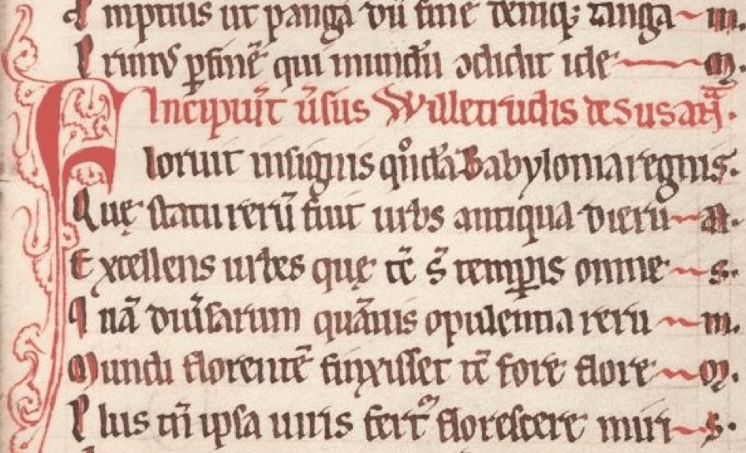
Clm 12513, fol. 24 where Willetrudis is named as the author of the poem ‘about Susanna’ (c) Bavarian State Library, Munich. Reproduced with permission.
We know little for sure about the life of Willetrudis the poet, but she has left us some clues. She is the named author of a 403-line Latin poem, ‘About Susanna’ (‘de Susanna’). This poem is a retelling of the biblical story of Susanna, a married woman falsely accused of adultery and subsequently exonerated by divine intervention (Daniel 13).
But who was Willetrudis? Within the poem, she refers to herself as a ‘scriptrix’, a female writer. She repeatedly uses first-person plural verbs and feminine endings, and she claims to use the example of Susanna to motivate her ‘sorores’ (her sisters) and fellow ‘famulae’ (handmaidens), words that are both regularly used for nuns in medieval Latin. Such language, along with the quality of her Latin, Classical references, and subject matter strongly suggests a highly intellectual Christian woman most likely placed within the literate world of a medieval convent. Despite the fact that the text comes from a manuscript in Germany, poetic and historical evidence suggests that it is more likely Willetrudis lived and wrote at the abbey in Wilton, England, a known center of creative literary production.
A German Manuscript, a German Nun?
The text is preserved in a single extant manuscript dating to 1240 and housed in the Bavarian State Library in Munich (Clm 12513, fols. 23-35). It was copied by a scribe named Liutold who was working in the Cistercian monastery of Raitenhaslach (just over 100 km from Munich). Seligenthal Abbey in Landshut, founded in 1232 and placed under the pastoral care of Raitenhaslach in 1426, thus may be where Willetrudis potentially lived and wrote. The nuns of Seligenthal actively participated in copying, producing, and maintaining manuscripts over centuries, but there is little evidence for a culture of creative literary production at the convent. She is identified as the author on fol.24r. The rubricated letters read ‘Incipiunt versūs Willetrudis de Susanna’ (‘So begin the verses of Willetrudis About Susanna’).
Following further clues, the name Willetrudis may have a Frankish origin. There was in fact a woman named Wiltrudis (note the slight spelling difference) who was the first abbess of the Bavarian Hohenwart Abbey founded by her and her brother, Count Ortolf, in 1074. As with Seligenthal Abbey, there is evidence for book production at the convent, but no evidence of literary production there.
A Literary Community at Wilton
A more promising location for our poetess is Wilton Abbey in Wiltshire, England. An ‘abbess Wiltrudis’ (‘abbatissa Wiltrudis’) appears on a scroll announcing the death of Vitalis of Savigny in 1122 (a mortuary roll) that requests prayers for his soul. Such mortuary rolls were circulated between communities, who would add responses (‘tituli’) in the form of poems or prayers and would often also append the names of their own dead. In the titulus from Wilton, abbess Wiltrudis’ name is placed prominently after a 14-line poem honoring Vitalis, written in the same meter as de Susanna (leonine hexameter) and featuring similar classicizing influences.

Detail of the mortuary roll for Vitalis of Savigny that identifies a ‘Wiltrudis’ at Wilton.
Unlike at the German abbeys, the women of Wilton were especially known for their education and literary output. The convent, founded c. 830, was a well-respected Anglo-Saxon royal nunnery and convent school. Only five Wilton manuscripts survive, because of (or despite) the destruction of the abbey in the 16th century during the Dissolution of the Monasteries.

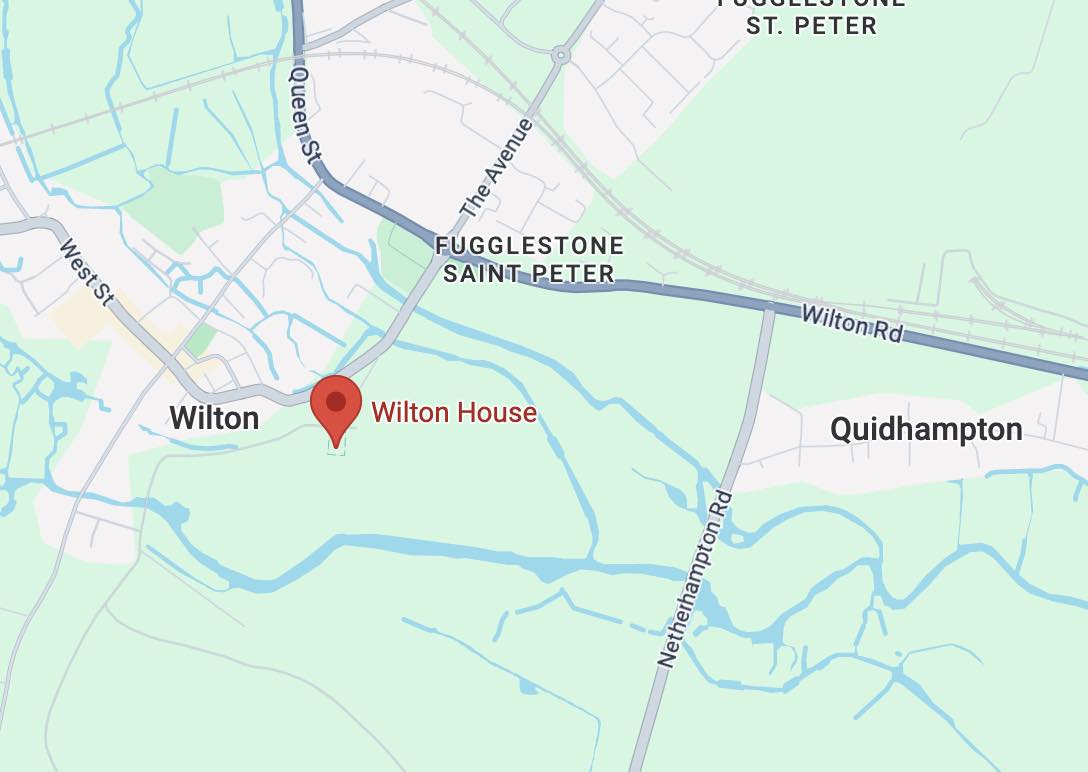
The east front of Wilton house built over the remains of the medieval Wilton Abbey.
Unfortunately, no text survives by Wilton’s most famous literary alumna, the poet Muriel, who, like the Wiltrudis of the Wilton titulus, lived at the beginning of the 12th century. In a text describing the 1113 journey of a group of priests from France to England, Herman of Tournai says that during their stop at Wilton Abbey they visited the grave of Muriel, whom he calls an illustrious poetess (‘inclyta versificatrix’, De Miraculis, PL 156, 983). Male poets celebrated the work of Muriel, and in a letter from Serlo, a canon of Bayeux, the convent at Wilton is admired as ‘a city rich in poetry’ (‘faecundam versibus urbem’, 3). In this same letter, Serlo admires Muriel’s skill and knowledge of Classical poetry. Such an environment suits the Willetrudis of de Susanna, who freely quotes Vergil and references classical mythology.
Susanna, who also features, albeit briefly, in other texts associated with Wilton, was just the sort of exemplum those living and working at Wilton might employ. Willetrudis offers a version of the story, tailored for nuns and future wives, that centers Susanna as a model of endurance and faith under pressure. As a nunnery and convent school, Wilton served a mixed audience of both religious and secular women, making the topic of a chaste woman’s reputation endangered by male accusations relatable to the entire population in the abbey.

Susanna and the Elders by Artemisia Gentileschi, 1610.
Despite the limited information Willetrudis provides about herself within the poem, the text hints at three possible locations: the German abbeys of Seligenthal and Hohenwart, or Wilton Abbey in England. Seligenthal was connected with the monastery that produced the only manuscript to preserve Willetrudis’ poem, but Hohenwart was founded by a noble woman named Wiltrudis. While there is evidence for book production at both houses, neither had the renown for creative literary production boasted by Wilton Abbey, the home of an abbess Wiltrudis who died in 1122. How Willetrudis’ ‘de Susanna’ ultimately ended up preserved in a single German manuscript remains a mystery, but Wilton clearly had a reputation for poetry that extended beyond England to the religious communities of the continent.
If you would like to read Willetrudis’ rendition of ‘de Susanna’, the Latin text, along with the first ever published translation of the full poem in English, is now available through Pixelia Publishing.
Further Reading
1. Editions and Translations
Gabriel Silagi, ‘Willetrudis Versus de Susanna: Eine Unbeachtete Frauendichtung Aus Dem 13. Jahrhundert’, Aevum 73, no. 2 (1999): 371–384. JSTOR
Abbe Walker et al., ed. and trans., Willetrudis: Verses about Susanna (Pixelia Publishing, 2026). Pixelia Publishing
2. Secondary Sources
Liz Herbert McAvoy, ‘Willetrudis’ in The Palgrave Encyclopedia of Medieval Women’s Writing in the Global Middle Ages, ed. Michelle M. Sauer, Diane Watt and Liz Herbert McAvoy (Cham: Palgrave Macmillan, 2023). DOI
Jane Stevenson, Women Latin Poets: Language, Gender, and Authority from Antiquity to the Eighteenth Century (Oxford: Oxford University Press, 2005).
Elizabeth Muir Tyler, England in Europe: English Royal Women and Literary Patronage, c. 1000–1150 (Toronto: University of Toronto Press, 2017).


,_Artemisia_Gentileschi.jpg)