Quantum Computing is a emerging and potentially transformative technology. It involves the construction and use of a fundamentally new type of computer which exploits some aspects of quantum mechanics in a way allowing the solution of problems which are provably too complicated for existing computing technology.
The Physics Department at Surrey is involved in research and teaching in quantum computing. Thanks to our research expertise, we run an MSc in Applied Quantum Computing, and our research covers areas from how to fabricate the building blocks of quantum computers, to how to exploit them with specially-developed quantum algorithms.
In the last week, we’ve have had two papers published in the journal Discover Quantum Science. They are both open access, so free for anyone to read, and they highlight the diversity of applications for quantum computation. Here’s a quick summary of both papers:
Last week, a paper called Motor Insurance Data Analysis By Quantum Machine Learning by Muhsin Tamturk et al. was published. The lead author is a recent graduate of our MSc programme, and the paper explores the use of quantum computers to perform machine learning in the context of the insurance industry. Bringing together a confluence of innovative techniques, including reservoir computing, the paper shows some of the promise of these methods in the financial sector.
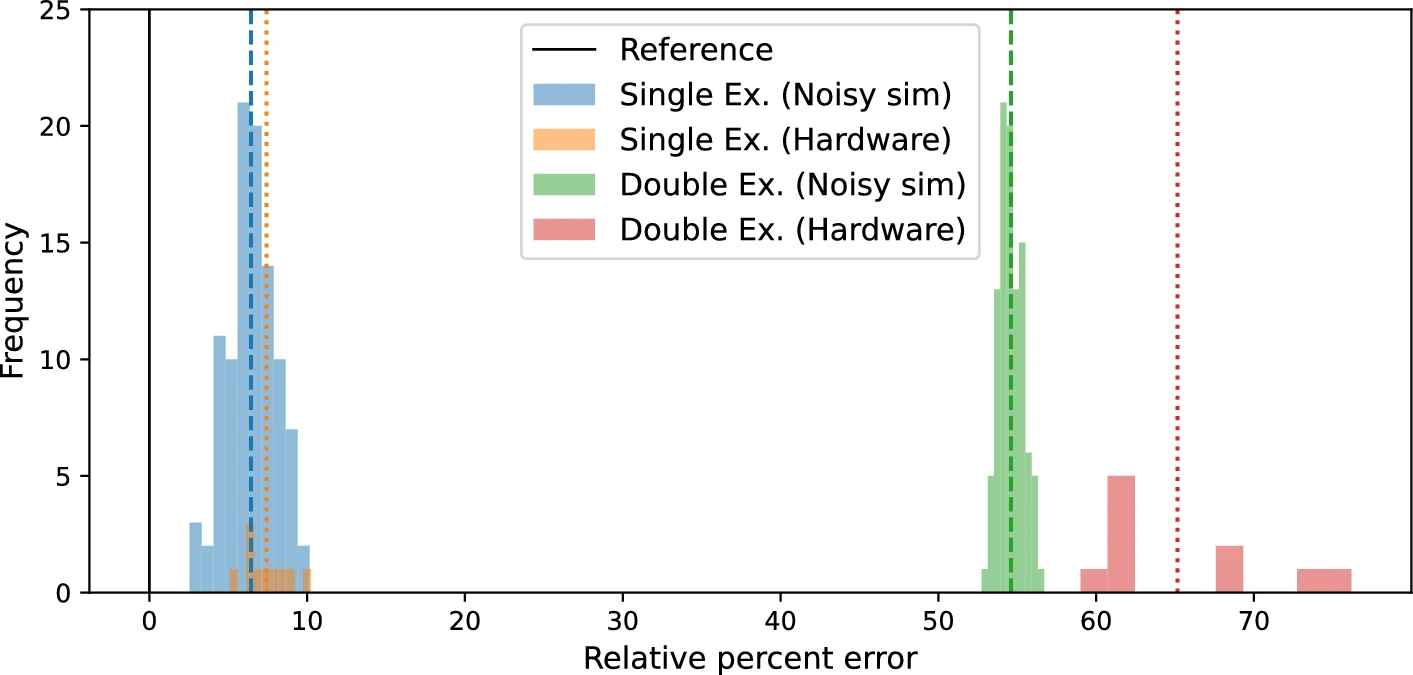
This week, a paper A low-circuit-depth quantum computing approach to the nuclear shell model was published. Led by Surrey postdoc Chandan Sarma, the work shows how quantum computers can be used to solve physics problems through quantum simulation. Using this method a quantum computer is teased into a state which is the analogue of a physical system of interest (in this case, the atomic nucleus) and then the computer’s state is measured, from which an equivalent measurement of a nucleus can be deduced. This is quite unlike the “number-crunching” method of using regular computers to understand physics problems. The work made use of some real quantum computers thanks to support from the UK National Quantum Computing Centre.
The image below shows a figure from the second paper, showing (before some error mitigation was applied) the kind of errors that quantum computers are currently subject to. It’s a fast-advancing field and we’re eagerly working towards applications for the so-called “fault-tolerant” era that awaits.